
Skin Anatomy/Hair Structure/Hair Growth Cycle
Skin Anatomy
The skin is the body’s largest organ, covering the entire body. In addition to serving as a protective shield against heat, light, and infection, the skin also: –
- Regulates body temperature
- Stores water and fat
- Is a sensory organ
- Prevents water loss
- Prevents entry of bacteria
- Assists in absorption and excretion
Throughout the body, the skin characteristics vary (i.e., thickness, colour, texture). For instance, the head contains more hair follicles than anywhere else, while the soles of the feet contain none. In addition, the soles of the palms of the hand are much thicker. Skin naturally exfoliates itself and produces sebum, which can directly affect durability of brows for each person.
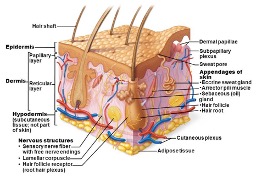
The skin is made up of the following layers, with each layer performing specific functions: –
- Epidermis
- Dermis
- Subcutaneous fat layer (subcutis)
Sectional view of skin and subcutaneous layer
Hair Structure
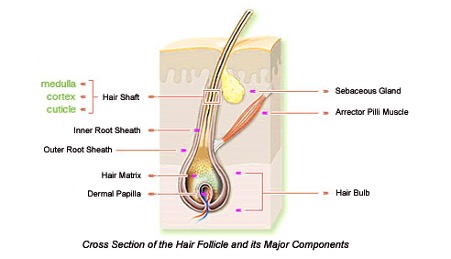
Human hair is composed of strong structural protein called keratin. This is the same kind of protein that makes up the nails and the outer layer of skin. Hair Cells develop in the pits in the skin called follicles, which reach down into the Dermis. Each hair grows from a follicle (a narrow tube in the skin).
The base of the hair is surrounded by a dermal papilla, which contains blood vessels that nourish all hair follicles and brings nutrients and oxygen – facilitating growth.
The papilla is surrounded by hair germ cells, which divide and eventually die, forming a hair shaft as the dead hair cells build up. The base of the follicle the hair is generally soft, it gradually hardens as it grows and when it reaches the skin surface it dies.
Each follicle has phases of growth and rest. Hair is made from these dead protein cells (Keratin). There are two parts to each strand of hair:
- The Hair Shaft – the part that extends above the surface of the skin.
- The Hair Root – The part below the surface of the skin.
Types of Hair
Hair is found all over the body – except for the soles of the feet the lips and palms of the hands. It grows to the various lengths and thickness (Vellus and Terminal), to allow for extra protection in that particular area.
Before we are born, the body is covered in LANUGO hair which is very soft and usually disappears at birth.
Vellus Hair
- Fine, downy and soft
- Usually found on the face and the body
- Usually, un-pigmented
- Rarely longer than 20mm
- Doesn’t have a medulla or a well-formed bulb
- Base of the hair is close to the skins surface – follicles aren’t deep which means that the hair shaft is usually straight even in ethnic origins.
Types of Vellus Hair
- Body hair – provides insulation as well as a sensory function.
Terminal Hair
- Grows from deep follicles, well defined bulbs
- Strong hairs – longer and coarser than Vellus
- Pigmented
- Vary greatly in shape, diameter, length, colour and texture
- Found on scalp, eyebrows, eyelashes, underarms, and pubic regions.
- In male pattern hair growth found on face, chest and back
Types of Terminal Hair
- Eyelashes – shade the eye from light, filter dust & dirt
- Eyebrows – Protect the eyes by absorbing sweat, and they cushion the brow bone (directly beneath the hair.)
- Scalp hair – Prevent heat loss from the body, protect the head against injury
- Underarms/Pubic area – Protect against infection
Each strand of hair is divided into three layers:
- The Cuticle (outer layer)
- The Cortex (middle layer)
- The Medulla (inner layer)
A healthy shaft will be very strong. It can stretch up to 30% of its length, absorb its own weight in water, and swell up to 20% of its diameter.
The Cuticle – The outer, protective coating of the hair. The cuticle is made from layers of overlapping scales and can be several layers thick (this make the hair waterproof and allows it to be stretched)
The cuticle protects the cortex and holds cells together. A healthy cuticle layer is what gives the hair its shiny appearance. If it is lost or damaged, the hair will look dull and become brittle because the cells in the cortex may break and unravel.
The coating is translucent, which allows the colour of the hair (from the cortex) to be seen.
The Cortex – The main bulk of the hair consists of long fibres, twisted together to form a rope.
At the centre of the finest threads of the cortex are three spiral, spring like chains that are bonded together.
The cortex contributes to the shape, mechanical properties and colour of the hair. The more bonds there are between the cells of the cortex, the curlier the hair will be. This layer contains most of the melanin, which gives the hair its colour.
The Medulla – This is the core of the hair, a supporting honeycomb keratin structure with air spaces in it. Aside from being a support, the Medulla also contains some of the cells that give it its colour.
Hair Growth Cycle
All hair on our bodies grows in three phases and the only thing that differs from hair on our head to eyebrows and lashes is how long the phases last. When an eyebrow hair or eyelash falls out it will grow back. Depending on the individual it takes approximately four to eight weeks to fully replace one hair. Each follicle can grow many hairs over a lifetime; the phasing of the growth cycle is staggered amongst the follicles. This means that they all don’t grow at the same time, or at the same rate.
Eyebrow and Eyelash Hairs grow in three phases: –
Anagen Phase – The Anagen or active growth phase, at which the hair grows lasts between 30 and 45 days. The length of this stage determines how long the hair will grow. During this phase, the cells in the root of the hair are dividing rapidly, adding protein and keratin to the hair shaft, causing it to grow and push upwards out of the skin. This stage ends when the blood supply stops, and hair detaches from the dermal papilla. About 40% of follicles are in this stage at any given time, which prevents us from periodic phases of baldness when the growth cycle stops.
Catagen Phase – At this stage the hair growth plateaus, and the hair follicle shrinks. This is also known as the transition phase. The follicle stops producing hair and the base moves upwards towards the surface of the skin. This phase lasts between 14 and 21 days. If an eyebrow hair or eyelash falls out or is pulled out this phase it will not grow back until the follicle has completed the Catagen phase and moved onto the next one.
Telogen Phase – This is the resting phase. Hair is fully keratinised and dead. It is in this last stage where the older hair falls out, since its root is closest to the skin. The Telogen phase can last more than 100 days before the hair falls out and a new one begins to grow, although it usually lasts around 2 months. Hair removal is easily and painlessly done with hairs in the Telogen phase.
As people age, the hair cycle can become shorter. The follicle gradually gives up producing long, strong hair and hair becomes thinner and stronger. This happens to lashes, brows and other parts of the body too. When the body is subjected to extreme stress, as much as 70 percent of hair can prematurely enter a Telogen phase.
Abnormal Hair Growth
Many things affect hair growth, including:
- Hirsutism – Male pattern of hair growth in females – hormone imbalance
- Hypertrichosis – Abnormal increased hair growth
- Generalised Hypertrichosis, which occurs over the entire body
- Localised Hypertrichosis which is restricted to a certain area
- Thyroid Conditions – Change the rate of growth
- Medications – Change the rate of growth
Both men and women can be affected, and it is usually determined by: –
- Number of follicles
- Cultural Influences
- Hereditary
- Hair strength and texture
- Illness
- Medication
- Hormones
- Emotion
Depilation Treatments have an effect on the hair. Regrowth hair, which occurs after tweezing or waxing is partially destructed at the follicle. These hairs are finer than the original hair growth, paler in colour and only shallowly placed in the skin, hence they are less visible and easier to remove.
Ingrown hair occurs when a hair emerges from the follicle and either grows along under the skin or turns and grows back into the follicle opening and becomes infected. This can occur as a result of plucking or waxing or by some distortion of the follicle.
The Hair Cycle and how growth can be affected is an important issue and should be explained to clients at the consultation stage.